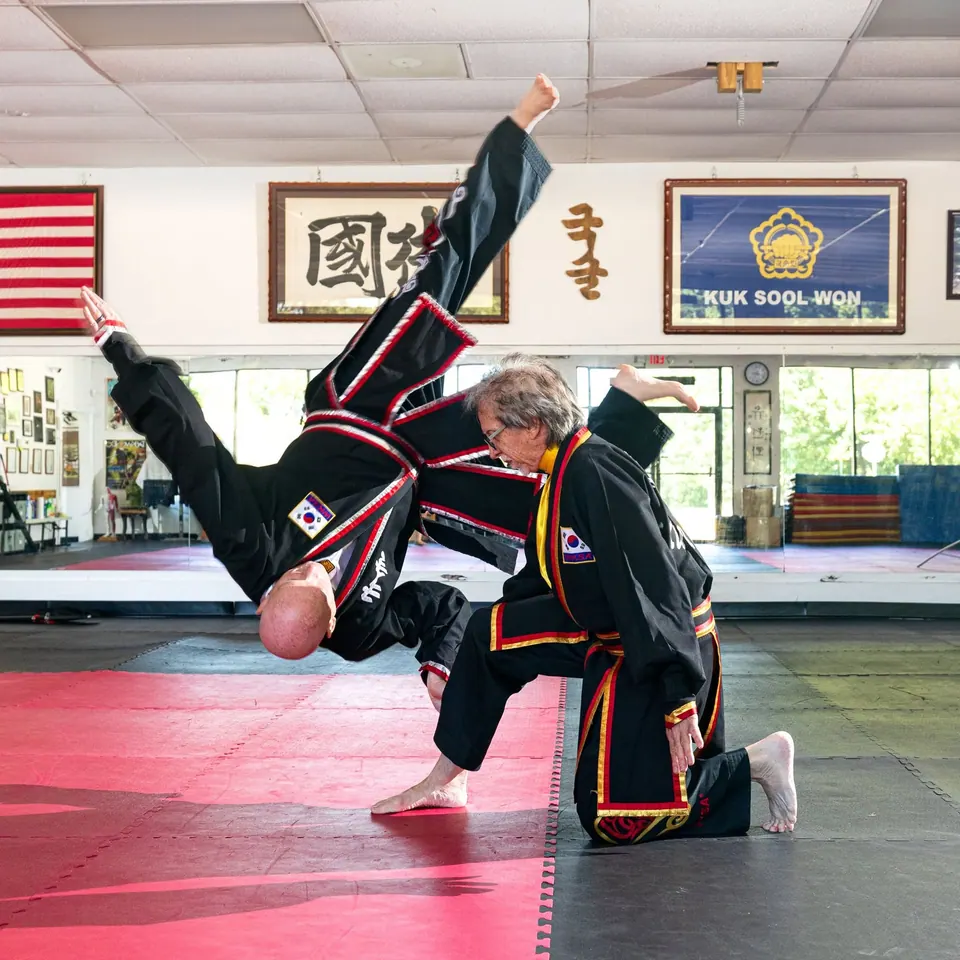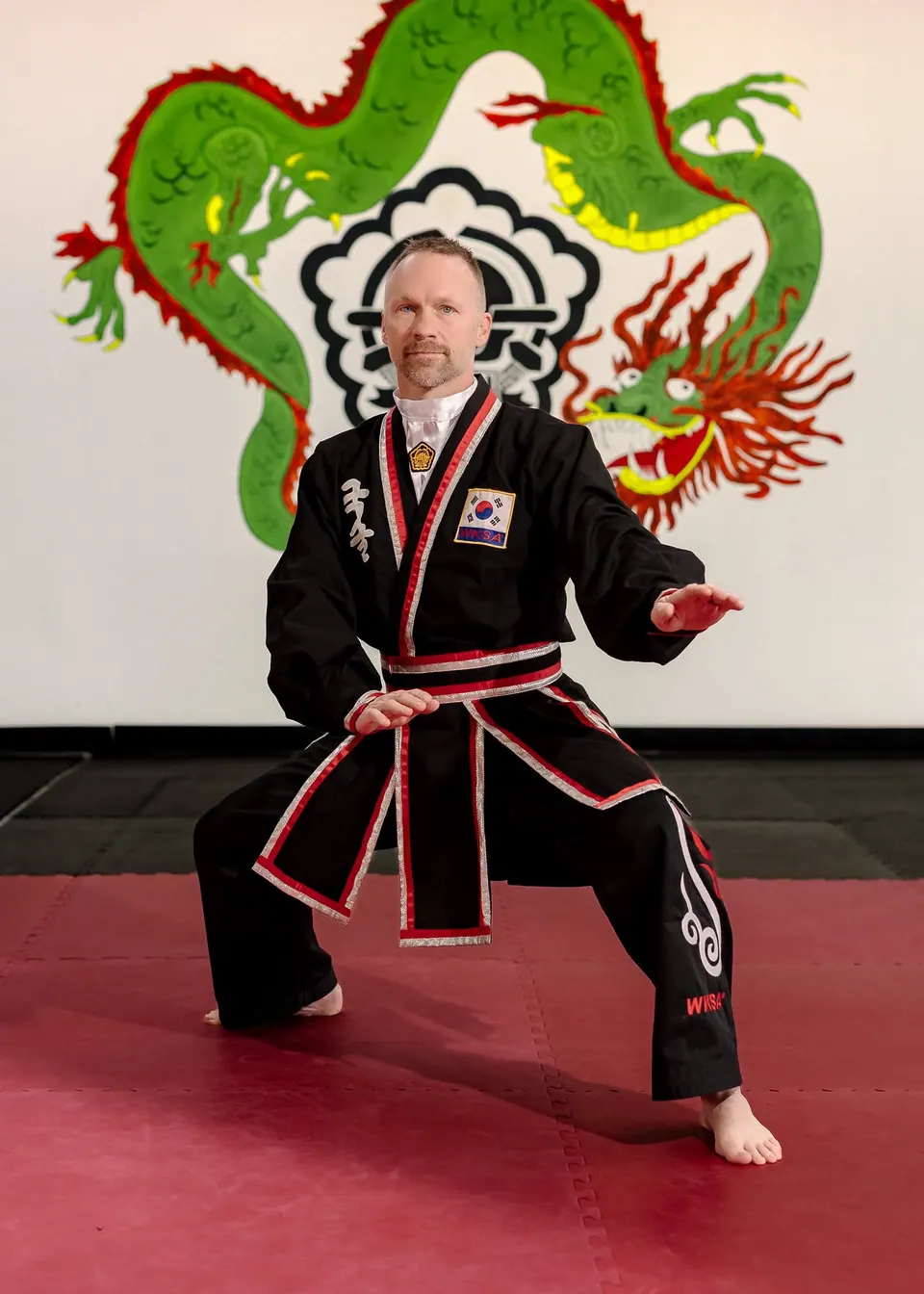
Kuk Sool Won is a comprehensive traditional Korean martial art. Comprehensive is the important word. Rather than specializing in one range or one method, it covers striking and kicking, throwing and grappling, joint locks, falling and acrobatics, traditional Korean weapons, and traditional healing arts, all inside one curriculum and one rank structure. The name translates roughly as "national martial art association," and the system was assembled by Grandmaster In Hyuk Suh from three separate historical traditions of Korean martial arts rather than invented from scratch.
That last part is what makes it unusual, and it is worth understanding before you compare it to anything else.
Quick facts
| What it is | Comprehensive traditional Korean martial art |
| Founder | In Hyuk Suh, known as Kuk Sa Nim |
| Founded | 1958, in Korea |
| Brought to the United States | 1974, with the World Kuk Sool Association formed in 1975 |
| Governing body | World Kuk Sool Association, headquartered in Texas |
| Built from | Three historical Korean traditions: tribal, Buddhist temple, and royal court |
| Covers | Striking, kicking, throwing, grappling, joint locks, falling, body conditioning, animal styles, weapons, healing arts, meditation and breathing |
| Where to train it near St. Louis | Kuk Sool Won of St. Louis, 1 Sutters Mill Rd Ste E, St. Peters, MO 63376 |
Where does Kuk Sool Won come from?
Kuk Sool Won draws on three distinct branches of Korean martial history, and almost everything distinctive about the art traces back to one of them.
SahDoh MuSool, the tribal and family martial arts. The oldest layer. These were the martial arts of clans and families, taught privately and handed down from one generation to the next, later broadened by village and community militias defending their own settlements. This is the root system that most Korean martial arts grow out of.
BoolKyo MuSool, the Buddhist temple martial arts. Developed by Buddhist monks from roughly the fourth century onward, both for health and for self protection while traveling. This branch is where the internal side of the art comes from: the breathing methods, the meditation, the emphasis on training the inside of a person rather than only the outside.
It is worth being clear about this one, because the word Buddhist makes some families hesitate. The temple contribution to Kuk Sool Won is not a religion and is not taught as one. It is a philosophy of conduct, a way of carrying yourself and living your life alongside other people. Nobody is asked to believe anything.
KoongJoong MuSool, the royal court martial arts. Kings, royal families and government officials kept private armies and personal bodyguards, and those bodyguards trained in a specialized art of their own. Because they worked at close quarters inside a palace, their methods leaned toward joint locking and pressure points, and toward small portable weapons that could be carried discreetly under court robes rather than a battlefield spear.
Kuk Sool Won is the combination of all three. That is the reason the curriculum is as wide as it is. You are not learning one tradition. You are learning what happened when someone spent a lifetime collecting three of them into a single organized system.
What do you actually learn in Kuk Sool Won?
You learn a wider range of material than most martial arts teach, and you keep learning it for a very long time. The curriculum includes hand striking and kicking techniques, throwing and grappling, joint locking techniques from the royal court tradition, falling and acrobatics, body conditioning, animal style techniques including tiger, crane and praying mantis, traditional Korean weapons, forms, traditional healing arts, and meditation and breathing training.
A student does not get all of this at once. It unfolds across ranks over years, which is the intended design. The breadth is not there to impress anyone on day one. It is there so the art still has something to teach you in year eight.
What weapons does Kuk Sool Won teach?
Kuk Sool Won trains a full range of traditional Korean weapons, introduced by rank as a student progresses. They include the long staff and the short staff, the middle staff, the jointed staff, the sword in both long and short forms and in single and double configurations, the spear, the cane, and rope techniques.
The royal court weapons are the ones people tend to remember, because they were built around concealment. A palace bodyguard could not walk around with a spear. What that guard could carry was something small and unremarkable enough to disappear inside a set of robes, which is exactly the constraint that produced some of the most technically interesting weapons in the system.
Is Kuk Sool Won a religion?
No. Kuk Sool Won is a martial art, not a faith, and students are not asked to hold any religious belief.
The confusion comes from the Buddhist temple branch of the art's history. What that branch contributed is a code of conduct and a set of internal training methods, breathing and meditation, not doctrine. Families of every background train in Kuk Sool Won schools around the world.
How is Kuk Sool Won different from karate, taekwondo or hapkido?
The short answer is breadth. Most well known striking arts specialize, and they are excellent at what they specialize in. Kuk Sool Won was assembled specifically to not specialize.
Taekwondo, for example, is a Korean art built heavily around kicking, with a strong sport and competition tradition. Karate is Japanese and Okinawan in origin and is primarily a striking art. Hapkido, also Korean, shares some technical ground with Kuk Sool Won in joint locks and throws. Kuk Sool Won overlaps all of them at the edges and then keeps going, into weapons, forms, animal styles, falling, acrobatics, internal training and healing arts.
Style matters less than most people assume, though. The instructor and the standard they hold matter far more, which is the subject of our companion article on what to look for when choosing a martial arts school.
Who founded Kuk Sool Won?
Kuk Sool Won was founded by In Hyuk Suh, known to students as Kuk Sa Nim, who founded the system in 1958 in Korea.
His training started with his own grandfather, Myung Duk Suh, when he was five years old. What followed was decades of study and of deliberately seeking out what remained of Korea's scattered martial traditions, much of which had been suppressed or driven underground during the Japanese occupation. Kuk Sool Won is the result of organizing what he gathered into one coherent system with a single curriculum.
In 1974 he brought the art out of Korea to the United States, and formed the World Kuk Sool Association in 1975, because his intent was never to keep it. He wanted the art shared, and he judged America the best place from which to do it. The association has since moved its headquarters twice, from San Francisco to Houston in 1991 and later to its current home in Texas, and Kuk Sool Won is now taught in dozens of countries and across most of the United States.
Why does the governing body matter?
Because it is what makes a rank mean something outside the building it was awarded in.
The World Kuk Sool Association publishes one standardized curriculum and certifies rank centrally across all of its member schools. A student who earns a belt at a member school has met the same requirement as a student at any other member school, anywhere in the world. Martial arts is otherwise an unregulated field, so that shared standard is not a formality. It is the difference between a credential and a colored piece of cloth.
The association also publishes a public directory of its member schools, which means you can verify any school's affiliation yourself without taking anyone's word for it.
Is Kuk Sool Won good for kids?
Yes, and the breadth of the curriculum is part of why.
Children get bored when they run out of material, and a great many kids quit martial arts at exactly the moment they start getting good, because there was nothing past the beginner syllabus. An art with weapons, forms, animal styles, falling and acrobatics waiting further up the ranks does not hit that wall. There is always a next thing, and the next thing looks nothing like the last one.
The falling and acrobatic training is also, in plain practical terms, the part parents end up most grateful for. A child who knows how to fall correctly is safer on a bike, on a playground and on a soccer field for the rest of their life.
Is Kuk Sool Won good for adults?
Yes. It is designed to be trained for a lifetime rather than for a season.
The internal side of the art, the breathing, the meditation, the conditioning, and the healing arts at advanced ranks, is the part that tends to keep adults engaged long after the initial novelty of learning to kick has worn off. Adults train alongside advanced students and see, weekly, what the art actually looks like when someone has spent twenty years on it.
Where can you learn Kuk Sool Won near St. Louis?
Kuk Sool Won of St. Louis is a member school of the World Kuk Sool Association, located at 1 Sutters Mill Rd, Suite E, in St. Peters, Missouri, and has taught at that address since 1995.
The school serves families from St. Peters, St. Charles, O'Fallon, Cottleville, Dardenne Prairie, Lake St. Louis, Weldon Spring and Wentzville. Classes run Monday through Friday from 3pm to 9pm and Saturday from 9am to 1pm, with programs for ages four and up, adults, families, and a Silver Dragons program for students fifty and over.
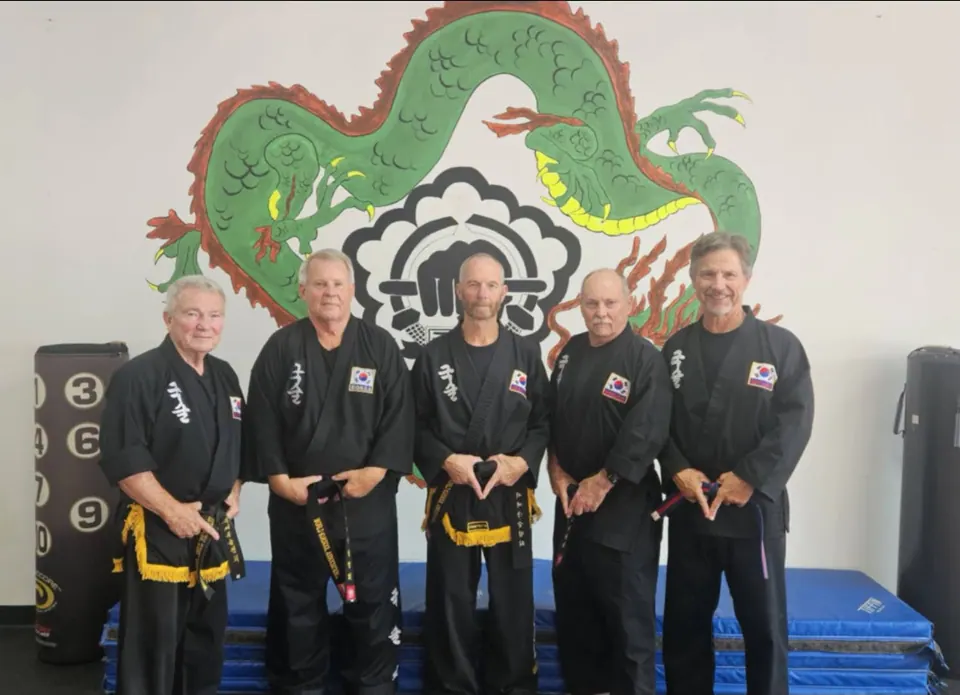
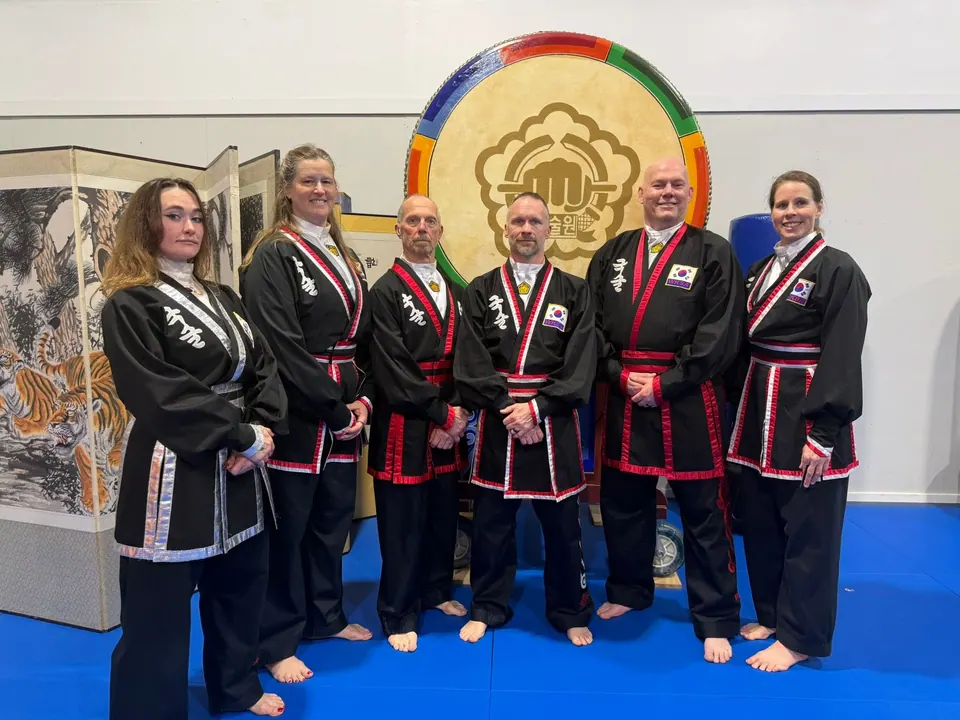
Instruction is led by SBN Jason Fisher. The school was established in 1995 by SSKJN Jack Harvey, who taught here for three decades and who is the reason it exists.
Frequently asked questions
What does Kuk Sool Won mean?
The name translates roughly as "national martial art association." Kuk refers to the nation, Sool to technique or art, and Won to an institution or association.
How do you pronounce Kuk Sool Won?
Kook Sool Won, with the first syllable rhyming with "book."
What country is Kuk Sool Won from?
Korea. It was assembled from three branches of Korean martial history and founded in Korea in 1958 before being brought to the United States in 1974.
Is Kuk Sool Won the same as hapkido?
No, though they share technical ground in joint locks and throwing. Kuk Sool Won covers a substantially wider curriculum, including weapons, animal styles, forms and traditional healing arts.
What age can a child start Kuk Sool Won?
Kuk Sool Won St. Louis teaches students from age 5, though readiness varies more by child than by age. Programs for the youngest students focus on coordination, listening and following instruction.
How long does it take to earn a black belt in Kuk Sool Won?
It depends on consistency more than anything else. A student who trains regularly tends to move through the color belt ranks in about two years and to reach black belt in about two years beyond that. That is a pattern rather than a promise.
Do you have to be fit to start?
No. You get fit by training. Nobody arrives in shape for a martial art they have not started yet.

Written for families by Kuk Sool Won St. Louis, an official member school of the World Kuk Sool Association, teaching at 1 Sutters Mill Rd in St. Peters since 1995.