The first ninety days are make or break. That is the honest version, and it is the version worth telling you before you start rather than after.
In three months you will either fall in love with this or you will find out it is not for you. Most people fall in love with it. But what decides it is almost never talent, and it is almost never fitness. It is whether anyone bothered to tell you what was actually going to happen.
So here is what actually happens.
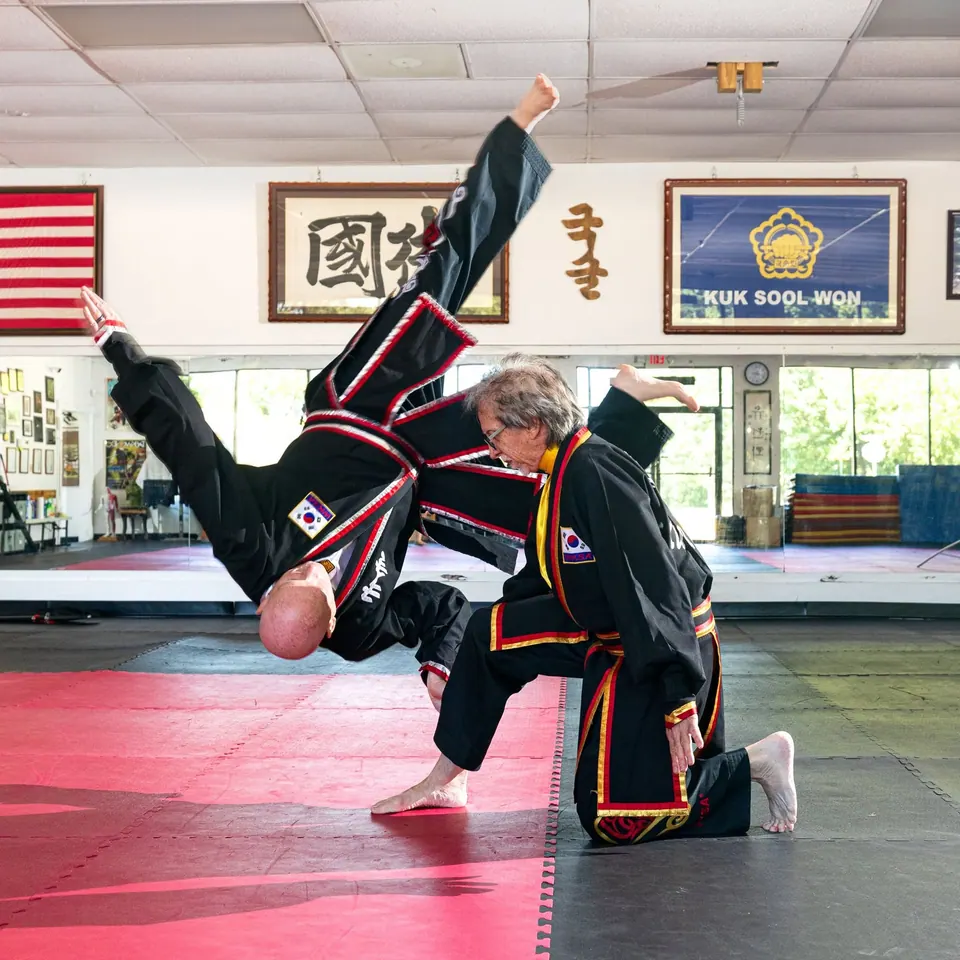
The short version: your first ten days are about learning how a class works, not about learning to fight. Your first thirty days add the Korean terminology and the etiquette. Somewhere around ninety days you may test for your first belt rank. Along the way the single most useful thing you learn is how to fall down without getting hurt.
Is starting a martial art intimidating?
Yes. Everyone finds it intimidating, including the people teaching you.
There is no point pretending otherwise. Walking into a room where everybody already knows the routine, wearing a uniform you just bought, being the only person who does not know when to bow, is uncomfortable. Our own instructor remembers exactly what it felt like to put that uniform on for the first time.
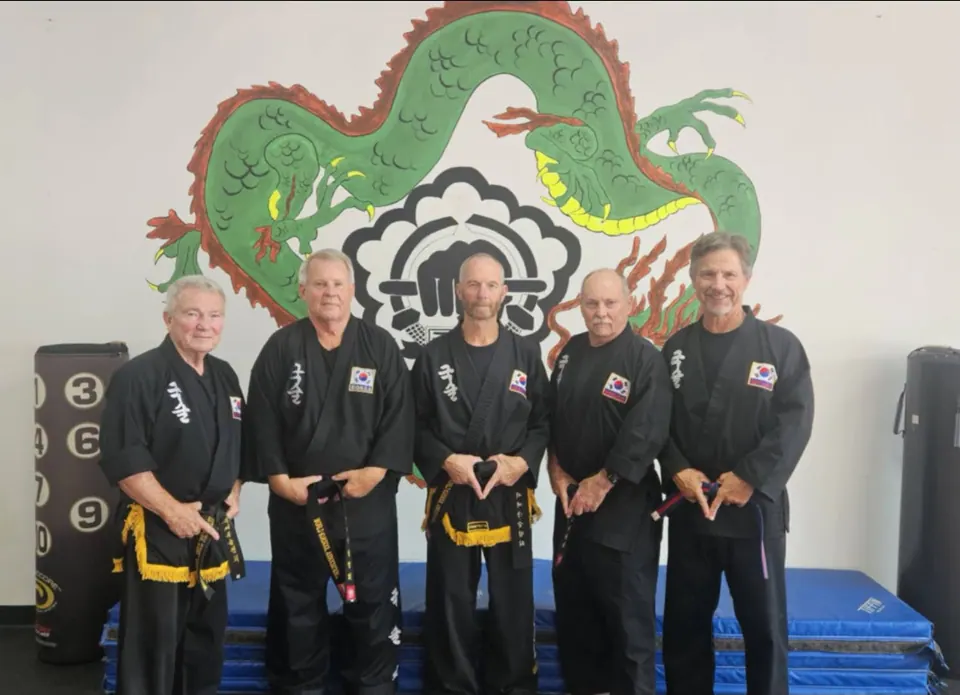
Here is the part that is easy to miss: every single black belt in that room went through the identical ten minutes you are about to go through. Not a version of it. The same one. That is not a motivational line, it is just how rank works. Nobody in that building skipped being a white belt.
What happens in your first ten days?
Your first ten days are about foundations and about learning how a class is structured, not about technique you would recognize from a movie.
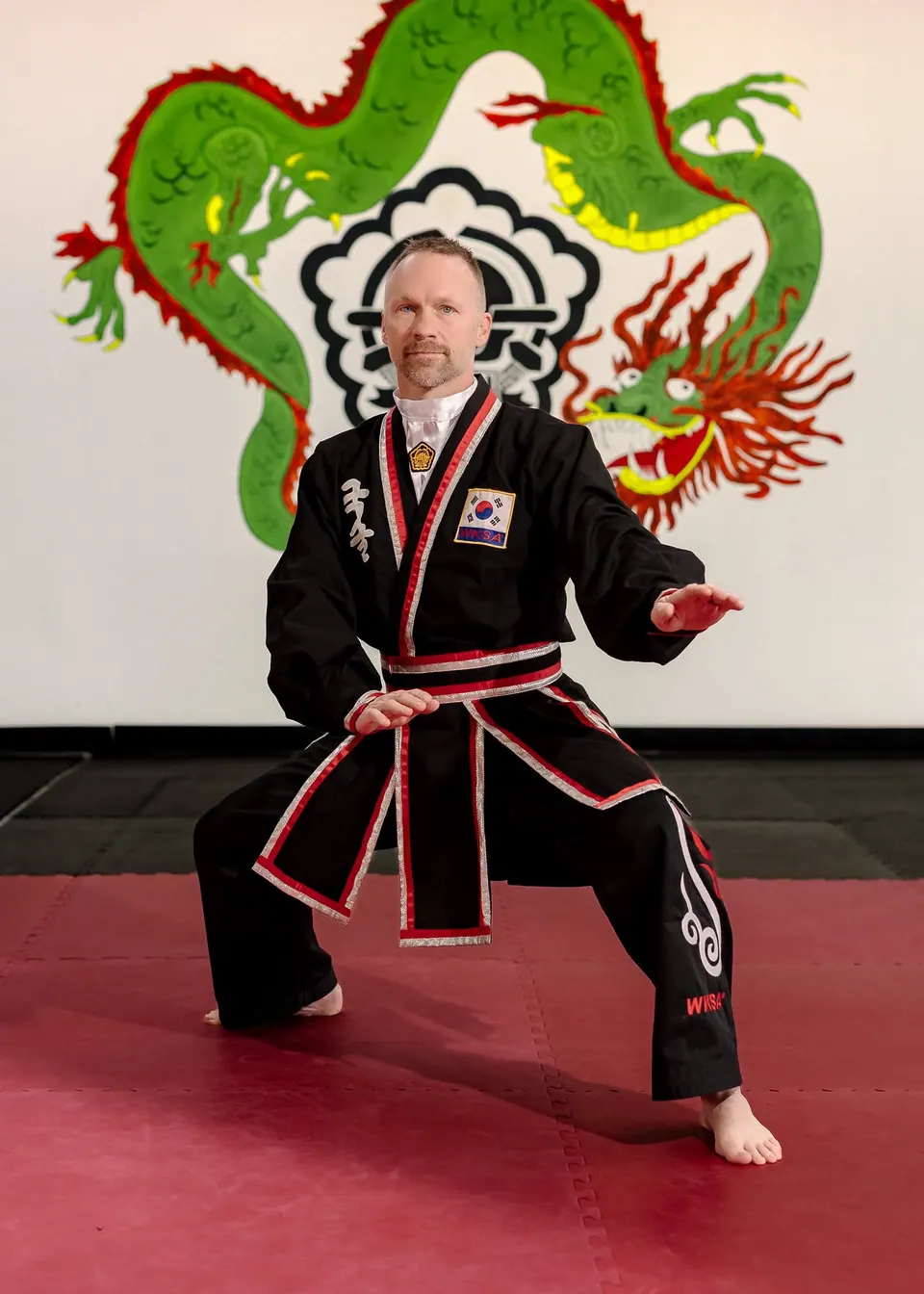
You learn how to bow into class and why. You learn the shape of a class, what comes first, what comes next, where you stand. You get introduced to the foundation techniques that everything later is built on.
And you get introduced to Mohm Pul Ki, our stretching and conditioning exercises, which open every class.
These first days are challenging, mentally more than physically. They are the days that ask you what kind of martial artist you actually want to be. But almost nothing in them is beyond a beginner. There is no hidden athletic requirement, nothing you need to already be able to do. Mostly it is repetition. Repetition, repetition, repetition, until the motions are correct rather than just approximate.
Why does every class start with stretching?
Because the warm-up is not a warm-up. It is training, and it has three specific jobs.
It is easy to assume the stretching at the start of class exists to make you sweat. It does not. Everything in a Kuk Sool Won class is there for a reason, and Mohm Pul Ki is doing this:
- Conditioning your body to perform the techniques, which are demanding in ways that ordinary fitness does not prepare you for
- Teaching you how to align your joints properly, which is the difference between a technique that works and a technique that hurts you
- Teaching you to stretch in a way that keeps you uninjured, which is what buys you longevity in this art
That third one is the one people underestimate. Longevity is the whole point. This is an art you can begin in your teens, your twenties, your seventies or your eighties, and still be training in decades later. That is only true if your body is not accumulating damage along the way, and the warm-up is where that gets decided.
When do you start learning Korean?
In roughly your first thirty days. Stances, kicks, strikes and counting are all taught in Korean, and you learn the terms as you learn the movements.
This is not decoration and it is not there to make things harder. It is there for two reasons.
The practical one: Kuk Sool Won uses a standardized curriculum across the World Kuk Sool Association. The Korean terminology is the shared language of that curriculum, which means a student from St. Peters can walk into a class anywhere in the world and follow along.
The real one: Korean culture is deeply traditional about respect, and the language carries that. You cannot separate the terminology from the culture it came out of. Learning the words is part of learning why the room works the way it does.
What is the deal with the bowing and the "yes sir"?
It is not about being harsh. It is about being understood, and about honoring people who have been at this longer than you.
This is the part that makes people hesitate, so let us be direct about it. In our school you address higher ranks with respect. You bow. You answer "yes sir" or "yes ma'am."
People sometimes read that as strict or severe. It is neither. There are two things actually going on.
The first is honoring elders and higher ranks. Someone who has been training for fifteen years has earned something, and acknowledging it costs you nothing. It is worth noting that this runs in both directions. A higher rank is expected to show you the same respect back. Rank does not entitle anyone to look down on a white belt in this school.
The second is purely practical, and it is the one nobody expects. When an instructor asks you something and you answer "yes sir," that answer is information. It tells the instructor you heard and understood. A nod in a room of thirty people is invisible. A spoken answer is not. It is a comprehension check with good manners wrapped around it.
For parents, that second point is worth sitting with. Your child is not being drilled into obedience. Your child is being taught to confirm out loud that they understood an adult. That skill transfers to a classroom, a job and a conversation, and it never stops being useful.
How does the belt system work?
Every belt rank has a role in the room, not just a color.
Kuk Sool Won progresses through color belts (white, yellow, blue, red, brown, and brown-black for black belt candidates) before the black belt ranks. Part of what you learn early on is what each rank means in practice: who you look to, who looks to you, how to address instructors and senior students, and the ordinary dos and don'ts of a training floor.
None of this is complicated and none of it is a memory test. It comes with repetition, the same way everything else does.
When is your first belt test?
Around the ninety day mark, though it is not a fixed date.
Somewhere in that window you may be asked to test on what you have learned so far, and passing earns you your first belt rank. There is no fixed interval between tests after that, either. How quickly a student is ready depends on three things:
- How consistently they attend class
- How well they have learned the terminology
- How well they are picking up new material
Which means the honest answer to "how fast will I advance" is: at the speed your own training earns. We will not promise you a date, because a promised date can only be kept by lowering the standard.
How long does it take to get good?
Wrong question, and we mean that kindly.
There is no end goal here. There is no finish line where the training is complete and you are done. Kuk Sool Won is a journey, and every person walking it has their own version of it. One student needs longer on the terminology and moves quickly through technique. Another is the reverse. Neither of them is behind.
It is not a race. Nobody is competing with the person next to them, and the only useful comparison is to the version of yourself that walked in ninety days ago. That is not a saying we put on a wall. It is how the art is structured, and it is a large part of why people are still training here after twenty and thirty years.
What should you bring to your first class?
Yourself, comfortable clothes you can move in, and nothing else.
You do not need a uniform to try classes. You do not need to be in shape first, which is a thing people talk themselves out of starting over, and it makes no sense: you get in shape by training, not before it. You do not need any prior experience with any martial art.
If you would rather watch a class before you try one, ask when you call. Then decide.
Take the first ninety days
Everything above is what the first three months look like from the inside. The only way to know whether it is for you is to stand in the room.
Kuk Sool Won St. Louis offers one week free, with no uniform required. Book your free week, take the 60 second quiz, or call (636) 928-0035.
1 Sutters Mill Rd Ste E, St. Peters, MO 63376. Classes Monday through Friday, 3:00 to 9:00 PM, and Saturday, 9:00 AM to 1:00 PM.

Written for families by Kuk Sool Won St. Louis, an official member school of the World Kuk Sool Association, teaching at 1 Sutters Mill Rd in St. Peters since 1995.